Why Your Nails Peel in Layers at the End of Summer — and How to Stop the Split
Quick Answer: End-of-summer peeling — onychoschizia, the layered splitting at the free edge — is mostly water’s fault: months of pools, ocean, extra hand-washing, and sweat cycle your nails through swell-and-shrink expansions that fatigue the glue between keratin layers, while chlorine, salt, sunscreen-washing, and acetone strip the lipids that seal them. The repair protocol is unglamorous and works: file the peeling edge smooth (never peel it off), keep nails shortish through recovery, oil the nails and cuticles daily with jojoba-based oil, moisturize after water contact, wear gloves for dishes, and give polish-remover cycles a rest. Expect visible improvement in the new growth within six to eight weeks.
Nails are a diary written in keratin: the tip you see today grew out three-plus months ago and has since survived your entire summer — every pool day, every beach weekend, every sunscreen wash-off. August peeling is July’s water bill arriving. The good news is that the same slow growth that delayed the damage makes the fix predictable, if you start it now.

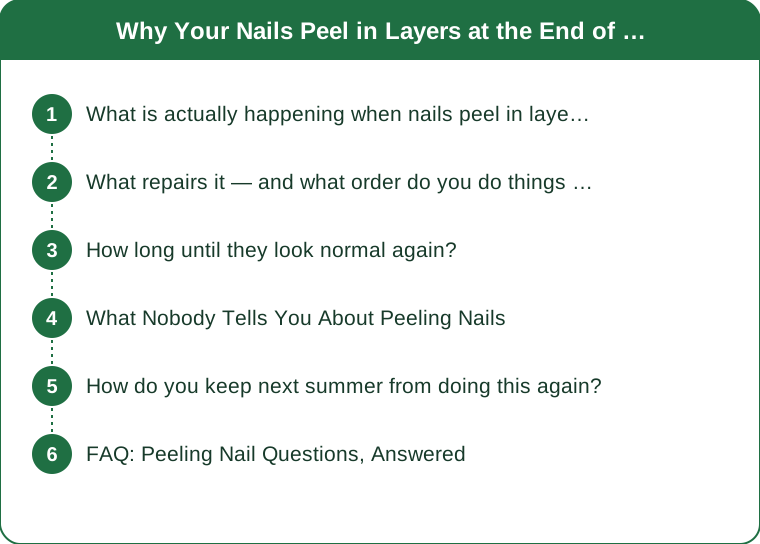
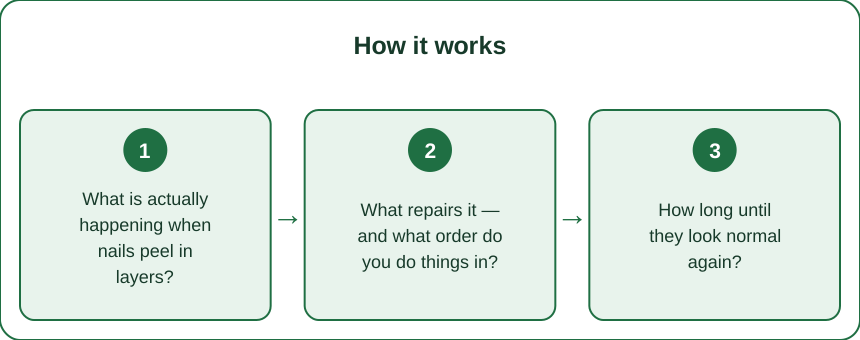
What is actually happening when nails peel in layers?
The plate is a laminate, and the laminate is delaminating.
A nail is roughly a hundred layers of flattened keratin cells, stacked like plywood and bonded by lipid-rich cement. The layered peeling you see — thin flakes lifting at the free edge, a tip that splits into two or three sheets — is that cement failing at the outermost layers, which is why the flakes are translucent and papery rather than the whole nail cracking through.
Water is the main saboteur, through repetition rather than presence. Nail keratin is far more porous than skin: soak a nail and it absorbs water and swells measurably; dry it and it shrinks back within the hour. One cycle is harmless. A summer of daily cycles — swim, shower, sunscreen wash-off, dishes, repeat — is thousands of expansion-contraction events, and the bonding between layers fatigues exactly the way any laminate fatigues under flexing. Dermatology literature is blunt on this: repeated wet-dry cycling is the leading driver of onychoschizia, which is why dishwashers, swimmers, and healthcare workers own the condition.
The chemical assists: chlorine and salt water each strip the lipid cement’s components and leave nails drier than fresh water alone; acetone removers dissolve lipids by design; and the free edge — unsupported and oldest — takes all of it with no ability to repair, because the visible nail is dead tissue. It cannot heal. It can only be managed while better nail grows in behind it.
What repairs it — and what order do you do things in?
A two-track protocol: damage control on the existing edge, better conditions for the incoming nail.
Track one, today: File — never peel — every lifting flake. Peeling a flake tears into intact layers below and doubles the project; a fine-grit file (240+ or a glass file) smooths the edge so it stops catching and propagating. File in one direction, not a saw motion, which itself frays layers. Then take the length down to short-with-a-slight-edge: a long free edge is a lever that flexing hands pry apart hourly, and short nails through recovery removes the leverage. Shape slightly rounded or squoval — sharp corners are split-starters.
Track two, daily: Oil is the star treatment, and jojoba-based cuticle oil is the standard because its molecular structure penetrates the plate rather than sitting on top. A drop rubbed into each nail and cuticle once or twice daily replaces the lipid cement summer stripped; a month of it visibly changes flexibility and sheen. Hand cream after every wash seals the water in rather than letting it flash-evaporate — the after-water timing is the whole trick.
Track two, situationally: gloves for dishes and cleaning (the single highest-value habit on this list), fresh-water rinse after pool or ocean, and remover holidays — if polish is a constant, switch to acetone-free remover and stretch the intervals.
A keratin-focused nail treatment or hardener has a place only in moderation: formaldehyde-family hardeners overshoot and make brittle nails that snap instead of peel. Flexible and sealed beats hard and glassy.
How long until they look normal again?
Set the calendar by growth rate, not by product promises.
Fingernails grow roughly 3 millimeters a month — a full plate replaces itself in four to six months. The peeling zone at your free edge will not un-peel; it grows off. What the protocol changes is everything behind it: expect the edge to stop worsening within two weeks of filing, gloves, and oil, and expect the nail arriving at the edge six to eight weeks in to be noticeably better bonded, with the fully-recovered nail landing around the three-to-four-month mark — conveniently, right about when holiday-season hands want to look their best if you start now.
During the wait, resist the two impatience traps. The first is over-treating — layering hardener on hardener, or filing the surface shine off repeatedly, both of which thin and stress the plate. The second is camouflage escalation: covering peeling with gel or acrylic seals the symptom while the removal cycle — soaking, scraping, acetone — costs more layers than the peeling did. If you want polish during recovery, a breathable-marketing-aside regular polish with acetone-free removal every week-plus is the low-tax version, and a ridge-filling base coat alone gives short natural nails a finished look with near-zero removal burden.
Track progress honestly with a monthly photo in the same light. Nail progress is invisible day to day and obvious month to month, and the photo is what keeps you from concluding at week three that nothing is working.

What Nobody Tells You About Peeling Nails
Your dominant hand peels worse, and it is not a mystery — it does more washing, more friction, more tool use, and more of everything that flexes free edges. Symmetric peeling on both hands with no water story is actually the more notable pattern (see the FAQ’s medical flags).
The picking habit is half the disease. A lifting flake is irresistible texture, and absent-minded peeling during meetings and podcasts converts one damaged layer into three. The fix is mechanical, not moral: file flakes the moment they appear so there is nothing to catch, and keep the file where the picking happens — desk drawer, car console, bag. People who stage files in three locations peel measurably less because the two-second intervention actually occurs.
Summer does not act alone; it recruits accomplices. Sunscreen application means extra hand-washing; sand is fine-grit abrasion; gardening without gloves adds soil moisture cycles; iced drinks sweat condensation onto fingertips all afternoon. None matters alone — the summer total is the story, which is why the peeling peaks in August and quietly resolves over autumn even for people who change nothing.
And a note on the supplement aisle: biotin has evidence for improving nail thickness in people with genuinely brittle nails, but deficiency is rare, results take months, and it does nothing about the wet-dry cycling that caused seasonal peeling — while quietly interfering with certain lab tests, including thyroid and cardiac panels, which your doctor should know about before any bloodwork. Gloves outperform gummies here by an embarrassing margin.
How do you keep next summer from doing this again?
Prevention is the same protocol run early and lighter — a maintenance dose instead of a rescue dose.
Start the oil habit in May, not August. A once-daily drop through swim season keeps the lipid cement topped up as the water withdraws it, and swimmers who oil consistently simply skip the late-summer peel. Pair it with the rinse-after-chlorine habit and the two changes cover most of the seasonal damage.
Keep summer nails shorter by default. The season of pools, sand, paddleboards, and open-toed everything is the season your nails flex most; a shorter edge all summer is leverage management, and the long-nail window can be autumn’s.
Make gloves a kitchen fixture rather than a resolution. The pair that lives visibly on the sink edge gets used; the pair under the sink retires. Dish gloves are the rare beauty intervention with instant compliance feedback — hands that end the week less dry are their own reminder.
Audit the remover cycle before high-polish seasons. If summer means weekly color changes for sandal season, acetone-free remover and a nourishing base coat are the terms of the treaty; if gel is your summer default, book removals professionally and never peel gel off a nail you plan to keep.
And fold nails into the end-of-summer transition you are already doing — the same weeks you shift skincare toward richer moisture and swap the wardrobe are the natural moment for a file-oil-photo reset. The nails growing in this month are the ones December will be wearing.
FAQ: Peeling Nail Questions, Answered
When is peeling a medical sign rather than a summer souvenir?
When it arrives with friends or without a cause: peeling plus significant hair shedding or fatigue (thyroid and iron territory), pitting or crumbling texture, dramatic color change, a single nail behaving unlike all others, or severe peeling with no wet-dry story at all. Any of those patterns is a checkup conversation — isolated tip peeling after a pool-heavy summer is not.
Can I just cut the peeling part off and be done?
Trim what is long, but cutting cannot chase peeling that extends flush to the fingertip — and clipping into the split often propagates it. Clip length, then file the edge smooth, and let growth do the rest. The scissors-only approach without the oil-and-gloves half just schedules a repeat.
Do glass files really matter or is that marketing?
They earn their reputation: fused-edge glass files cut cleanly at a fine effective grit and seal the edge rather than fraying it, which matters most on already-peeling nails. A fine-grit standard file used one-directionally is a fine substitute; the coarse emery board sawed back and forth is the actual villain of the drawer.
Is it the sunscreen itself damaging my nails?
Not meaningfully — sunscreen chemistry is not a notable nail stressor. The connection is behavioral: sunscreen season means several extra hand-washes a day to de-grease palms, and those wash cycles are straight wet-dry fatigue. Wash, dry, moisturize is the fix; skipping sunscreen is not on the table.
TL;DR:
- Layered peeling is delamination: summer’s thousands of wet-dry swell cycles plus chlorine, salt, and removers fatigue the lipid cement between keratin layers.
- Rescue protocol: file (never peel) flakes with a fine or glass file, keep nails short through recovery, jojoba-based oil daily, moisturize after every wash, gloves for dishes, remover holidays.
- The visible edge cannot heal — expect stabilization in two weeks, better new growth by week six to eight, full turnover in three to four months. Photograph monthly.
- Prevent next year’s peel with a May-to-September maintenance dose: daily oil, post-swim rinses, shorter summer length, and a glove pair that lives on the sink.
File every lifting flake tonight, put the oil bottle next to your toothbrush, and let the timeline work. The nails that ring in the holidays are being built this week — by the boring habits, as usual.
Keep Reading
This article is for general informational and styling purposes only. Fit, sizing, and product availability may vary.