Why Does Filing Your Nails Right After a Shower Cause Splits?
Quick Answer: Nail plate can absorb a substantial amount of water, and a soaked nail swells and softens. A file dragged across it separates the keratin layers rather than shaving them cleanly, so the edge closes up looking fine and splits along those separations once it dries. Wait about an hour after a shower, or file before it.
Everyone files after a shower because the nails are soft and it feels easier.
That softness is the entire problem.
This is general information, not medical advice.

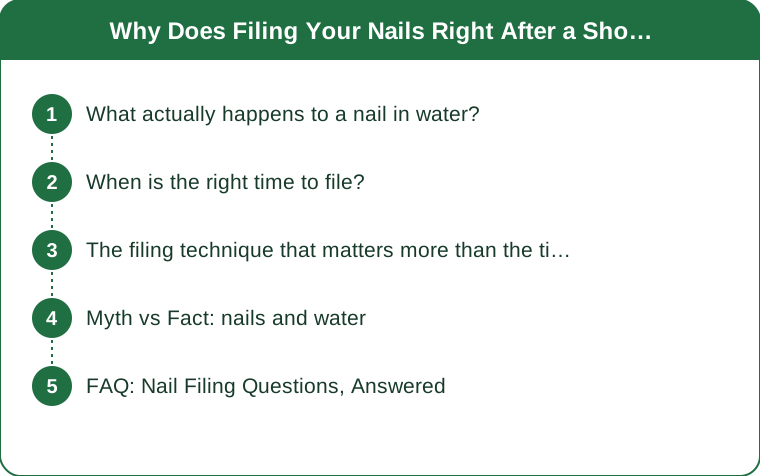
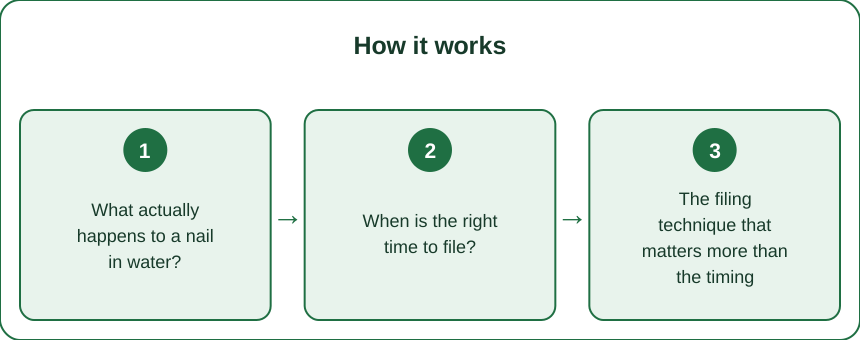
What actually happens to a nail in water?
It takes water on, and it takes on more than most people would guess.
The nail plate is made of stacked keratin layers held together by bonds that are sensitive to hydration. Submerged or under a hot shower, the plate absorbs water, and its water content can rise several-fold from its normal state. The visible result is a nail that flexes, feels rubbery, and appears slightly larger — which is also why rings feel tight after a bath.
A hydrated nail is more flexible and less resistant to shear. That sounds like it should file more easily, and it does. The trouble is what easier means here: instead of abrading the free edge, the file grabs the softened layers and drags them apart from each other.
You cannot see it happen. The edge looks smooth, because the separated layers are still lying against one another and the water is holding them there.
Then the nail dries over the next few hours, contracts, and the separations open. That is the peel that appears two days later with no obvious cause.
Is this the same reason nails peel at the end of summer?
Related. Repeated wet-dry cycling — swimming, washing, humidity — stresses the bonds between layers regardless of filing. Filing wet adds mechanical separation on top of a plate that is already cycling.
When is the right time to file?
Dry, and at least an hour after any significant water exposure. A nail returns most of the way to its normal water content within roughly that window in ordinary indoor conditions.
The most reliable slots:
- Before a shower rather than after. Same convenience, opposite hydration state.
- Mid-morning, well after washing up. Nails have had hours to normalize.
- Evening, before applying oil. File first, then hydrate — never the other way round.
And a genuinely useful test: flex the free edge gently with a fingertip. If it bends easily and feels soft, it is still hydrated. A dry nail has a distinct springiness and resists.
What about clipping instead?
Clipping wet nails has the same problem in a worse form — a clipper applies sudden compressive force across the whole edge, and a softened plate crushes and splits rather than cutting. If you clip, dry is even more important than it is for filing.
Does this apply to gel or acrylic?
No, and that is why the advice sounds unfamiliar to people who wear enhancements. A cured gel or acrylic surface is not absorbing water the way a natural plate does. This is a natural nail issue specifically.

The filing technique that matters more than the timing
Timing is half of it. Direction and grit are the other half, and they compound.
Use a fine enough file. Natural nails generally want 180 to 240 grit. Coarse files — the 100 grit boards intended for acrylic — remove material fast and leave a torn edge with microscopic separations, which is the same damage pattern as filing wet, arrived at differently.
File in one direction, or at least finish that way. Sawing back and forth works both edges of every keratin layer and encourages separation. Whether strict one-direction filing is essential is genuinely debated, but finishing with unidirectional strokes and a light touch is a low-cost habit that reliably produces a cleaner edge.
Seal the edge. After shaping, run the file flat along the underside of the free edge at a shallow angle, very lightly, or use a buffer. This closes the layer ends and is the step that most visibly reduces peeling.
Stop before it looks perfect. Most peeling damage comes from the last ten strokes, chasing a shape that the nail was not going to give you today.
Then oil, after — not before. Cuticle oil on the nail plate and the underside of the free edge helps maintain flexibility. Applied before filing it just makes the plate softer at the worst moment.
Myth vs Fact: nails and water
Myth: Soaking nails before a manicure is good practice. Fact: Soaking is common in salons and it does soften cuticle tissue, but it also swells the nail plate. Many technicians have moved toward waterless manicures partly because polish adheres better to a plate that has not absorbed water and then shrunk under the colour.
Myth: Soft nails are healthy nails. Fact: Temporarily soft from water is a hydration state, not a health state. Chronically soft, thin, or bendy nails when dry is a different situation and can relate to health or repeated chemical exposure.
Myth: Nails need to breathe between manicures. Fact: Nails have no blood supply of their own and do not exchange gas — the plate is dead keratin. Breaks between enhancements can still help, but the reason is mechanical recovery and rehydration, not breathing.
Myth: Peeling means a vitamin deficiency. Fact: Sometimes, but mechanical and environmental causes are far more common — water exposure, filing technique, detergents, and dry air. Biotin has some evidence for brittle nails, though the effect is modest and slow. If peeling is sudden and affects all nails, that is worth mentioning to a clinician.
Myth: A metal file is fine if you are gentle. Fact: Metal files are typically much coarser than the effective grit for a natural nail, and gentleness does not change the grit. A glass or fine emery file is a better tool for the same job.
FAQ: Nail Filing Questions, Answered
How long after washing my hands do I need to wait?
Brief handwashing is not the same as a shower. Fifteen or twenty minutes is usually enough after a quick wash; a long bath or swim needs closer to an hour.
What about filing after washing dishes?
That is one of the worst times — hot water plus detergent, often for ten minutes or more. It softens the plate and strips lipids at the same time. Gloves for dishes solve more nail problems than any product does.
Does the season change this?
Yes. Dry indoor air in autumn and winter pulls moisture out faster, so nails swing between wet and very dry more sharply than they do in humid weather. That cycling is hard on the plate, which is why peeling often worsens once heating comes on.
Is a glass file really better?
For natural nails, generally yes. Glass files have a fine, consistent abrasive surface, they do not degrade the way emery boards do, and they can be washed. They are also easy to over-file with because they feel gentle, so the light-touch rule still applies.
My nails split even when I file dry — what now?
Look at exposure rather than technique: frequent hand sanitizer, cleaning products, acetone removal, or very dry indoor air. Also consider whether the shape is too long or too pointed for how you use your hands. If nothing accounts for it and the change was sudden, it is worth a conversation with a clinician.
TL;DR:
- Nails absorb water and soften; a file then separates keratin layers instead of shaving them.
- The damage is invisible while wet and shows up as peeling once the nail dries.
- File dry, at least an hour after a shower — or simply file before one.
- Use 180 to 240 grit, finish in one direction, seal the underside of the free edge, then oil.
- Wet clipping is worse than wet filing; gloves for dishes prevent more than any product fixes.
The convenient moment and the correct moment are opposites here, which is exactly why this habit is so widespread. Moving it fifteen minutes earlier costs nothing.
This is general information, not medical advice.
Keep Reading
This article is for general informational and styling purposes only. Fit, sizing, and product availability may vary.