Why Your Manicure Chips in Two Days and Your Friend's Lasts a Week
Quick Answer: Manicures chip early because of oil left on the nail plate, polish applied too thickly, skipping the free-edge cap, or an incompatible base and top coat. Dehydrate the nail with rubbing alcohol before the base coat, apply three thin layers rather than two thick ones, and cap the tip on every single coat. Those three changes typically double wear time.
You did everything the same way she did. You bought the same brand. You even waited longer to be sure it dried.
Two days later you have a chip on your index finger and she is on day seven with a manicure that still looks fresh.
The difference is almost never the polish. It is four specific things in the preparation and application, and every one of them is free to fix.

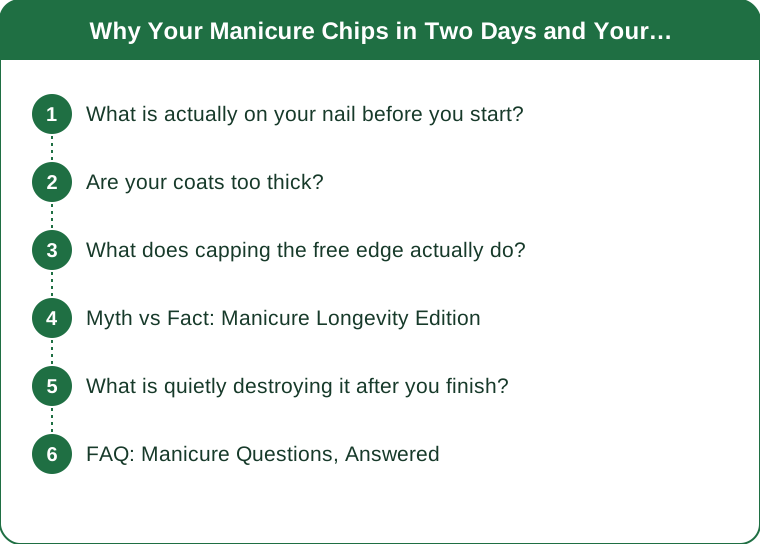
What is actually on your nail before you start?
Oil, and it is the single largest cause of early chipping.
Your nail plate produces and absorbs oil continuously, and it also picks it up from hand cream, cuticle oil, soap residue, and simply touching your face. Polish does not adhere to oil. It sits on top of it and lifts as a sheet, which is why chips often come off in a large piece rather than flaking gradually.
The fix takes fifteen seconds:
- Wipe each nail with rubbing alcohol or acetone on a lint-free pad immediately before the base coat. This is the highest-value step in the entire process.
- Do it after any filing or buffing, not before — filing releases oil from within the nail plate.
- Do not touch your nails after wiping. Handle by the sides of your fingers.
Do not apply cuticle oil before painting. Save it for after everything has fully cured, which is at least an hour later. Applying oil first is well-intentioned and it guarantees lifting.
If you wash your hands right before, wait five minutes. Nails absorb water and swell slightly, then shrink as they dry — polish applied over a swollen nail cracks as the nail returns to normal.
Are your coats too thick?
Almost certainly, and it is the second biggest factor.
Thick polish coats dry from the outside in. The surface skins over while the layer underneath stays soft for hours, sometimes days. A manicure that feels dry on top and is soft underneath dents, smudges, and chips at the slightest impact — and you have no way to know it is happening.
The correct approach:
- Three thin coats beat two thick ones, always. Total thickness is similar, drying is dramatically better, and the color is more even.
- Wipe most of the polish off the brush on the bottle neck. You want a thin bead, not a loaded brush.
- Wait two minutes between coats. Rushing this is where thick-coat problems originate.
- The first coat can look streaky and patchy. That is correct. It is a foundation layer, not a color layer.
A useful test: press a fingernail gently into the polish 30 minutes after finishing. If it leaves any mark, the layers were too thick. Properly thin coats are dent-resistant well before that point.
What does capping the free edge actually do?
It seals the tip, and skipping it is why chips almost always start at the end of the nail.
Capping means running the brush along the very edge of the nail — the thin horizontal surface at the tip — after painting the surface. It takes about two seconds per nail.
The free edge is where every mechanical stress lands. Typing, opening things, washing dishes, reaching into a bag. Without a seal, water and friction get under the polish at that edge and lift it.
The technique:
- Cap on every single coat, base included, color included, top coat included. Especially the base — that is the layer that actually bonds.
- Swipe the brush horizontally across the tip, lightly. Do not press.
- Include the top coat cap, which is the layer doing the protective work.
This one habit is frequently the entire difference between a two-day and a six-day manicure, and it is the step most commonly skipped because it feels fussy and unimportant.
Also leave a hairline gap at the cuticle — a fraction of a millimeter. Polish touching the cuticle lifts as the skin moves, and it makes the whole manicure peel from the base.

Myth vs Fact: Manicure Longevity Edition
Myth: Expensive polish lasts longer. Fact: Formula quality varies, but prep and application dominate the outcome by a wide margin. A drugstore polish over a properly dehydrated nail with capped edges will consistently outlast a luxury polish applied over oil.
Myth: You should buff the nail smooth before polishing. Fact: Light buffing to remove shine helps adhesion. Aggressive buffing thins the nail plate, weakens it, and creates a surface that flexes more — which cracks polish faster. A few light passes only.
Myth: Quick-dry drops make the manicure dry. Fact: They cure the top surface. The layers underneath still need hours. Quick-dry products prevent smudging, which is genuinely useful, and they do not make the manicure impact-resistant sooner.
Myth: You can mix any base coat with any top coat. Fact: Chemistry matters. Some combinations, particularly pairing a gel-effect top coat with a regular base, shrink at different rates and cause peeling. If a manicure keeps failing, try matching base and top from the same line before changing anything else.
Myth: Cold water helps polish set. Fact: An old trick that firms the surface and does nothing for the solvent evaporation happening underneath. It can also introduce water under the edges. Time is the only thing that actually cures polish.
What is quietly destroying it after you finish?
Water and heat, more than any impact.
Hot water is the main culprit. Prolonged exposure — long showers, dishwashing, baths — causes the nail plate to absorb water and expand. Polish does not expand with it, so it separates and lifts. A hot shower within two hours of painting will noticeably shorten a manicure.
Practical protections:
- Wear gloves for dishes and cleaning. The single most effective habit for anyone who paints their nails regularly.
- Avoid hot water for at least two hours after finishing, and preferably paint in the evening after the day’s water exposure is done.
- Apply cuticle oil daily, starting the day after. Counterintuitively, flexible nails chip less than brittle ones, and oil applied to the cuticle and nail plate keeps them flexible. It just cannot go on before the polish.
- Reapply top coat every two to three days. Thirty seconds, and it restores the protective layer and the shine. This is what salon manicures effectively do by being thicker to begin with.
- Stop using your nails as tools. Opening cans, scraping labels, prying anything. Most first chips have a specific identifiable cause, usually about eighteen hours in.
FAQ: Manicure Questions, Answered
How long should I really wait between coats?
Two minutes for thin coats, and up to five before the top coat. The top coat is where impatience costs the most — applying it over an under-dried color layer traps solvent and produces a manicure that stays soft and dents for days.
Does a base coat actually matter?
Substantially. It creates a bondable surface, prevents staining from dark pigments, and is the layer that adheres to the nail. Color polish alone on a bare nail chips within a day or two for most people.
Why do my nails chip faster than my toes?
Hands do everything and are in water constantly. Pedicures routinely last three to four weeks for the same reason — feet are protected, dry, and not being used to open things.
TL;DR:
- Wipe every nail with alcohol right before the base coat. Oil is the number one cause of chipping.
- Three thin coats, two minutes apart. Thick coats stay soft underneath for days.
- Cap the free edge on every coat, and leave a hairline gap at the cuticle.
- Hot water within two hours is the biggest post-manicure risk. Gloves for dishes, always.
- Refresh the top coat every two to three days — thirty seconds buys days of wear.
Do the alcohol wipe and the free-edge cap on your next manicure and change nothing else. Most people see wear time roughly double from those two habits alone, which makes the rest of the list feel like refinement rather than work.
Keep Reading
This article is for general informational and styling purposes only. Fit, sizing, and product availability may vary.