Why Your Gel Manicure Lifts at the Exact Same Spot Every Single Time
Quick Answer: Gel polish reliably lifts first at whichever nail or spot experiences the most repeated mechanical stress or oil exposure — often the dominant hand’s most-used fingers, or a specific nail with a naturally different growth angle or curvature that makes the gel bond less evenly there — meaning the pattern is mechanical and structural, not random, and worth addressing at prep rather than blaming the polish brand.
It’s always the same nail, the same edge, the same spot. That consistency isn’t a coincidence or bad luck with a particular gel brand — it points to a specific, repeatable mechanical or structural reason at that exact location.


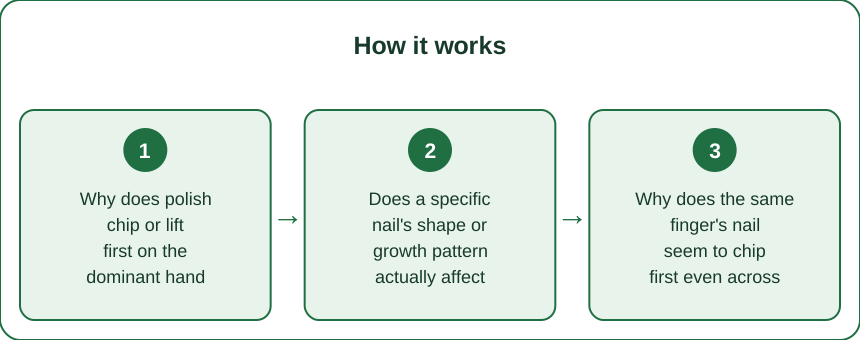
Why does polish chip or lift first on the dominant hand specifically?
The dominant hand experiences meaningfully more friction, impact, and general use throughout the day — typing, opening containers, general fine motor tasks — all of which apply repeated mechanical stress to the nail edge and surface that the non-dominant hand simply doesn’t encounter as often, making it the more likely spot for gel to lift first.
Does a specific nail’s shape or growth pattern actually affect gel adhesion?
Yes — nails with a more pronounced curve, a naturally uneven surface, or a slight ridge can create spots where gel polish has a thinner or less even bond during application, since the gel needs full, even contact with the nail surface to cure and adhere properly across its entire area.
Why does the same finger’s nail seem to chip first even across different gel brands?
If the underlying cause is mechanical (repeated impact or friction at that specific spot) or structural (that nail’s particular shape or ridge pattern), it will affect any gel brand applied there similarly, since the brand isn’t the variable — the nail and how it’s used every day is.

Does cuticle or edge prep at that specific nail matter more than people realize?
Yes — incomplete cuticle removal or an unbuffed edge at that specific nail creates a physical gap where gel can’t bond as securely, and if prep is slightly less thorough at one particular nail (often one that’s harder to reach or file evenly, like the ring finger on a dominant hand), it becomes the predictable weak point.
Is there a fix once the pattern is identified?
Extra attention during prep specifically at that identified nail (more thorough buffing, ensuring a fully dry and oil-free surface before application) and being mindful of unusually rough tasks on that finger can meaningfully extend how long the gel holds there before lifting starts.
FAQ: Gel Manicure Lifting Patterns, Answered
Does switching gel brands usually fix a consistent lifting spot?
Rarely, if the cause is mechanical or structural rather than brand-related — the same spot typically shows the same pattern regardless of brand.
Should extra base coat be applied specifically at the problem nail?
A thin, even, fully cured base coat matters more than extra thickness — too much product can actually cause its own adhesion problems rather than solving them.
Is it normal for the ring finger specifically to chip first for many people?
Yes, commonly reported — the ring finger often receives less deliberate care during daily tasks and can have a slightly different curve than other fingers, both contributing to this common pattern.
TL;DR:
- Consistent lifting at the same spot points to mechanical stress or nail structure, not brand quality
- The dominant hand’s most-used nails experience the most repeated friction and impact
- A nail’s specific curve or ridge pattern can create uneven gel adhesion at that exact spot
- Extra prep attention at the identified problem nail extends wear time more than switching gel brands
Before blaming your next gel brand, check whether the same specific nail and spot has been the pattern all along — the fix is usually in the prep, not the product.
Keep Reading
This article is for general informational and styling purposes only. Fit, sizing, and product availability may vary.