Why Your Gel Manicure Cracks at the Same Knuckle Every Time
Quick Answer: Gel polish cracks fastest at the finger that bends most during your daily tasks (usually the index or middle finger), because gel is rigid and can’t flex with repeated joint movement the way your skin does.
You get a fresh gel set, and within four days one specific knuckle — always the same one — has a hairline crack while the rest of your nails look flawless. It’s not bad luck and it’s not a bad polish batch. It’s biomechanics.

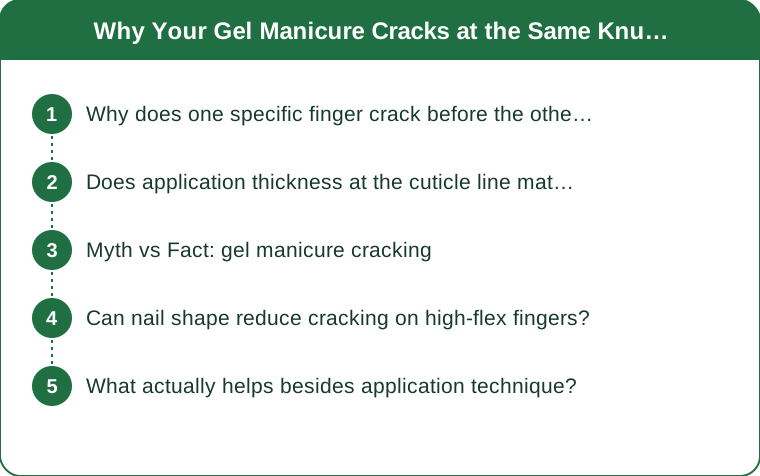
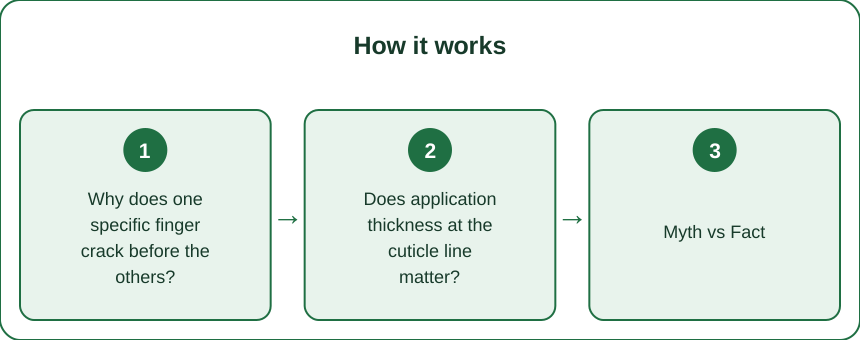
Why does one specific finger crack before the others?
Gel polish is a rigid, cured film — it has almost no flex. Your skin and nail bed flex constantly, and the finger you bend most during typing, texting, or gripping takes the most repeated micro-stress at the same crease point.
For most people that’s the index or middle finger, since those bend the most during a normal day of typing and phone use.
Does application thickness at the cuticle line matter?
Yes — a slightly thick gel layer right at the eponychium (the skin fold at the base of the nail) creates a stress point exactly where the skin flexes most during a fist or grip motion. Thin, even coats at the cuticle line flex less because there’s less rigid material to crack.
Ask your tech (or check yourself if you self-apply) to thin out the layer specifically at that fold — most cracking happens within 2mm of it.

Myth vs Fact: gel manicure cracking
Myth: cracking means the gel brand is bad. Fact: almost any gel brand cracks at a high-flex joint if applied too thick there — it’s a technique issue more than a product one.
Myth: a longer cure time prevents cracking. Fact: over-curing makes gel more brittle, not more durable — it can make cracking worse, not better.
Myth: cracking always means it’s time for a full removal. Fact: a small hairline crack can often be sealed with a thin top coat layer if caught early, buying another week before it needs full removal.
Can nail shape reduce cracking on high-flex fingers?
A slightly shorter length on your most-used finger reduces the leverage that flexing puts on the polish — the longer the nail, the more torque a bend applies to the base where cracks start.
This is a small, easy fix: even 1-2mm shorter on just that one nail meaningfully cuts down on the stress it takes.
What actually helps besides application technique?
Cuticle oil applied daily keeps the surrounding skin more flexible, which reduces the sharp mechanical stress transferred into the polish at the fold. It won’t stop cracking entirely, but it noticeably slows it down on high-flex fingers.
TL;DR:
- Rigid gel meets a high-flex joint, and the joint always wins first
- Thin, even application right at the cuticle line matters more than the brand
- A slightly shorter length on your most-used finger reduces crack-causing leverage
- Daily cuticle oil slows it down; it won’t fully prevent it
The crack isn’t a sign your manicure failed — it’s a sign one finger is doing more work than the polish was ever built to flex with. Adjust the technique there, and the rest of the set holds just fine.
Keep Reading
This article is for general informational and styling purposes only. Fit, sizing, and product availability may vary.