Why Your Manicure Always Chips First at the Same Two Nails
Quick Answer: Polish typically chips first on the dominant hand’s thumb and index finger because those nails absorb the most friction from daily tasks like typing, opening containers, and using a phone — the fix is extra top coat reinforcement specifically on those two nails, not redoing the whole manicure differently.
If it’s always the same two nails, that’s not bad luck — it’s the two nails doing the most physical work every day.

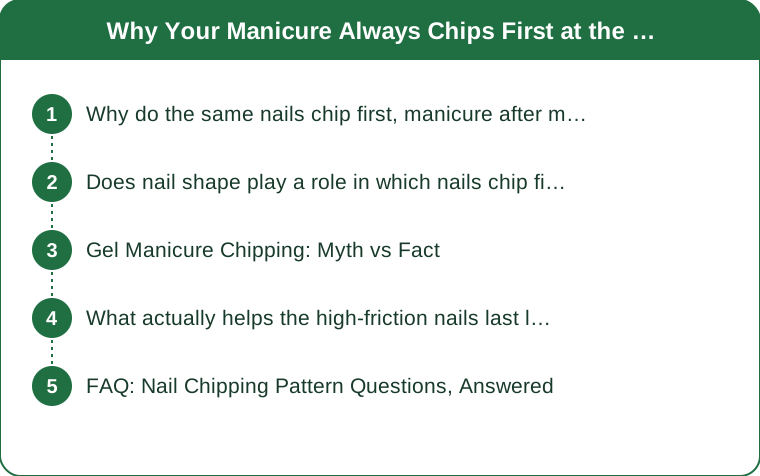
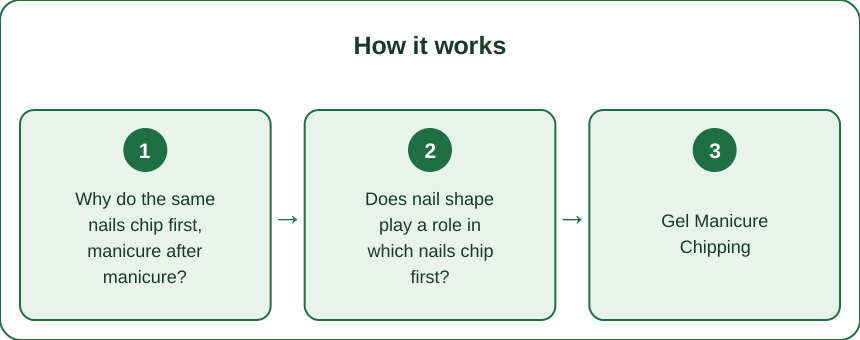
Why do the same nails chip first, manicure after manicure?
The dominant hand’s thumb and index finger contact more surfaces throughout an average day than any other nails — phone screens, keyboards, zippers, jar lids — and that repeated friction wears down polish and top coat faster than on less-used nails.
This is a mechanical, predictable pattern, not inconsistent application, which is why the same nails chip first manicure after manicure.
Does nail shape play a role in which nails chip first?
Nails with more exposed free edge, like squoval or almond shapes on the index finger, catch on surfaces more than shorter, rounder shapes, adding extra chip risk on top of the friction factor.
This compounds with the thumb and index finger’s high-friction daily use, which is part of why those two nails specifically tend to chip before the rest.

Gel Manicure Chipping: Myth vs Fact
Myth: gel polish doesn’t chip if applied correctly. Fact: even a well-applied gel manicure will show earlier wear on high-friction nails — gel resists chipping better than regular polish, but it isn’t immune to the same friction pattern.
Myth: chipping always means the manicure was done poorly. Fact: uneven wear across nails is often about friction exposure, not application quality — a manicure can be flawless and still chip unevenly.
What actually helps the high-friction nails last longer?
Applying an extra thin layer of top coat specifically on the thumb and index finger, re-capping the free edge fully, reinforces exactly the spot taking the most wear without adding bulk to the rest of the manicure.
Re-applying top coat to just those two nails every few days, rather than waiting for a full redo, extends the life of the whole manicure since the other nails typically aren’t chipping yet.
FAQ: Nail Chipping Pattern Questions, Answered
Should I just keep those two nails shorter to prevent chipping?
It can help, since less exposed free edge reduces catching, but it’s optional — reinforcing top coat achieves a similar result without changing your preferred length.
Does hand cream or oil affect how fast nails chip?
Heavy oil applied right over fresh polish can affect adhesion, but nail oil applied to the surrounding skin, avoiding the polish itself, doesn’t meaningfully increase chip risk.
Is this pattern different for people who don’t type or use their phone much?
Yes — the specific high-friction nails shift based on someone’s actual daily tasks, though the thumb and index finger remain common due to near-universal actions like opening containers.
TL;DR:
- Dominant-hand thumb and index nails chip first due to daily friction, not inconsistent polish
- Nail shape with more exposed free edge adds to the chip risk on those same nails
- Gel polish reduces but doesn’t eliminate this friction-driven pattern
- Targeted top coat reinforcement on just the high-friction nails extends the whole manicure’s life
The pattern isn’t bad luck — it’s data about which nails are working hardest, and it points straight to the fix.
Keep Reading
This article is for general informational and styling purposes only. Fit, sizing, and product availability may vary.