How to Remove Gel Polish at Home Without Wrecking Your Nails
Quick Answer: File off only the top coat, soak cotton in pure acetone, wrap each nail in foil for 12 to 15 minutes, then gently push the softened gel off with a wooden stick. Never scrape, peel, or pick — that removes layers of the nail plate along with the gel, and that is the cause of the thin, ridged nails people blame on gel itself. Re-wrap for another five minutes if any gel resists rather than forcing it.
Properly applied and properly removed, gel does very little damage to the nail plate. The problem is that removal is boring and picking is satisfying, and one satisfying afternoon costs three months of nail recovery.

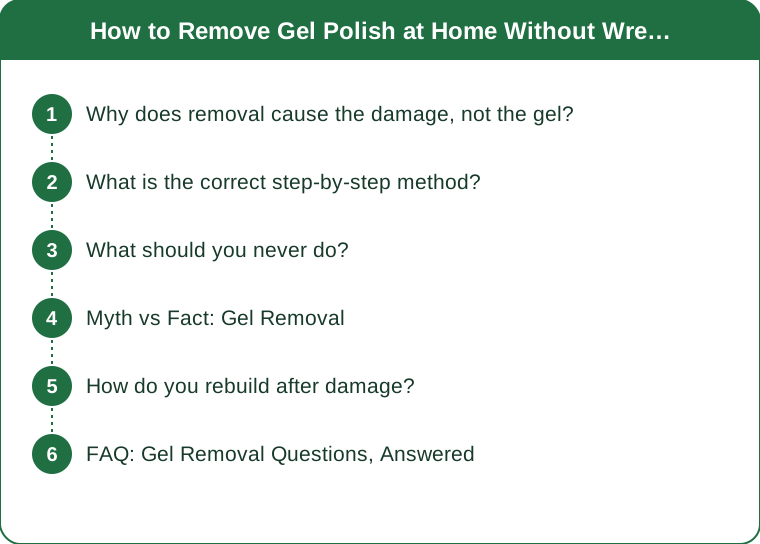
Why does removal cause the damage, not the gel?
Because the nail plate and cured gel bond tightly, and force separates them at the wrong layer.
Your nail plate is made of stacked keratin layers. Cured gel adheres to the top of that stack. When you peel or pick gel off, the separation does not happen neatly at the boundary — it takes the top one to three keratin layers with it.
That is why a picked-off manicure leaves nails that feel thin, rough, and bendy. You have physically removed part of the nail, and it takes three to four months to grow out because nails grow roughly 3mm per month.
Acetone works differently. It breaks down the gel polymer itself so the gel loses adhesion and lifts as a softened mass, with no mechanical stress on the keratin underneath.
The secondary cause is over-filing. Filing all the way down to the nail plate rather than just breaking the top coat thins the nail directly. You only need to remove the shine, which is perhaps 30 seconds of light filing per nail.
What is the correct step-by-step method?
Seven steps, about 25 minutes total.
1. Protect your skin. Apply a thick balm, petroleum jelly, or cuticle oil to the skin around each nail. Acetone is extremely drying and this single step prevents most of the irritation people associate with removal.
2. File the top coat. A 180-grit file, light pressure, until the surface goes from shiny to matte. Stop the moment the shine is gone. You are breaking the sealed top layer so acetone can penetrate, nothing more.
3. Soak cotton in pure acetone. Not nail polish remover — most contain water and conditioners that slow the process considerably. 100 percent acetone, available for $5 to $8.
4. Wrap. Cotton on the nail, foil wrapped firmly around the fingertip. Pre-cut foil wraps work well and cost a little more.
5. Wait 12 to 15 minutes. Set a timer. This is the step people shorten and it is the one that matters.
6. Push, do not scrape. Remove one foil at a time and push the softened gel from cuticle to tip with a wooden orange stick. It should come away like a soft film. If it resists at all, re-wrap for five more minutes.
7. Buff lightly, then oil. A gentle buff to smooth any residue, then cuticle oil and hand cream immediately.
What should you never do?
Five things, in descending order of harm.
Peeling it off. The worst of all, and the most common. A gel manicure that is already lifting at the edge feels designed to be peeled. It is not.
Picking at it during the day. Same damage, distributed over a week so you notice it less.
Filing down to the nail. Using a coarse file to grind through the whole gel layer removes nail plate along with polish. Electric files in untrained hands are particularly effective at this.
Using a metal cuticle pusher to scrape. Metal is harder than your nail plate. If the gel is not soft enough to push with wood, it is not ready.
Soaking your whole hand in a bowl of acetone. It works, and it exposes all your skin to a strong solvent for 15 minutes. The foil method delivers the acetone only where it is needed.
One more that surprises people: do not immediately reapply gel after removal. Give the nail a day, with oil applied several times, before the next application. The plate is dehydrated right after acetone exposure and adhesion is actually worse.

Myth vs Fact: Gel Removal
Myth: Gel ruins your nails. Fact: Removal ruins nails. Studies and salon experience both point to mechanical damage during removal, not the product, as the primary cause of thinning and ridging.
Myth: Soaking longer is more damaging. Fact: Under-soaking is far more damaging, because it leads to scraping. An extra five minutes of acetone is much gentler than three minutes of force.
Myth: You need a break between gel manicures for the nails to breathe. Fact: Nails are not living tissue and do not respire. What they do need is recovery from any damage already done, and hydration. If your nails are healthy and removal is done properly, back-to-back gel is fine.
Myth: Acetone-free remover is gentler. Fact: It is gentler on skin and largely ineffective on cured gel, which means longer soaking and more scraping. Pure acetone plus skin protection is the better trade.
Myth: Peel-off base coats solve everything. Fact: They remove the acetone step but they rely on weak adhesion, so wear time is short. And peeling anything off a nail carries some risk of taking surface layers, even when it is designed to release.
How do you rebuild after damage?
Time, oil, and patience — in that order of importance.
Cuticle oil twice daily. A jojoba or almond-oil based product applied at the nail fold, morning and night. This is the highest-impact thing you can do and it takes ten seconds. Oil penetrates the nail plate far better than water-based creams.
Keep them short while they recover. Longer damaged nails leverage against the weak plate and break lower, which extends the recovery. Trim to just past the fingertip until the ridging grows out.
Skip strengtheners with formaldehyde. They harden the plate temporarily and increase brittleness with continued use. A simple hydrating base coat does more good.
Wear gloves for washing up. Repeated wet-dry cycling is the main ongoing stressor for a recovering nail, and hot water plus detergent is worse than acetone ever was.
Expect three to four months for a full grow-out from the cuticle to the free edge. As indoor heating starts in the coming weeks, add a second oil application — dry heated air noticeably increases brittleness, and recovering nails feel it first.
FAQ: Gel Removal Questions, Answered
How long should gel stay on before removal?
Two to three weeks is the usual window. Leaving it longer is not harmful to the nail directly, but as the nail grows the gel leverages at the free edge and is more likely to lift or crack — and lifting is what tempts people to pick.
Can I remove gel with a nail drill at home?
Not recommended without training. Electric files remove material extremely fast and the difference between removing gel and thinning the nail plate is a fraction of a millimetre. Salon technicians train specifically for this.
Why do my nails feel bendy right after removal?
Acetone temporarily dehydrates the nail plate, which reduces stiffness. This resolves within 24 to 48 hours with oil and normal hydration. If bendiness persists past a few days, that is damage rather than dehydration.
TL;DR:
- Damage comes from removal technique, not from gel itself — peeling takes keratin layers with it.
- File only until the shine is gone, then foil-wrap with pure acetone for 12 to 15 minutes.
- Push softened gel with a wooden stick; if it resists, re-wrap rather than scraping.
- Protect skin with balm first, oil immediately after, and wait a day before reapplying.
Set a timer next time and let the acetone do the work. Fifteen boring minutes now saves the three months of grow-out that impatience costs.
Keep Reading
This article is for general informational and styling purposes only. Fit, sizing, and product availability may vary.