How to Care for Nails When the Air Turns Dry
Quick Answer: Nails contain water, and nail plate water content falls when ambient humidity drops - which is exactly what happens when heating comes on and outdoor air cools. Dry nails are more brittle and split along the layers, producing peeling and hangnails. The fix is sealing water in rather than adding more: apply cuticle oil to damp nails twice daily, wear gloves for washing up and cold weather, and file in one direction with a fine grit. Soaking nails frequently makes it worse, not better.
The seasonal timing is the clue that it is environmental rather than nutritional.

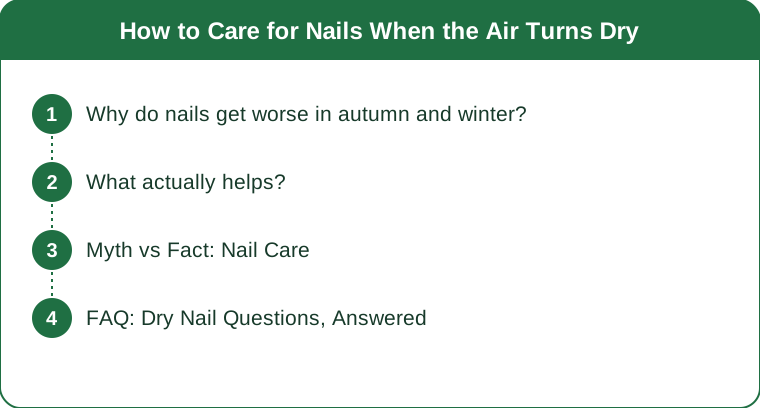
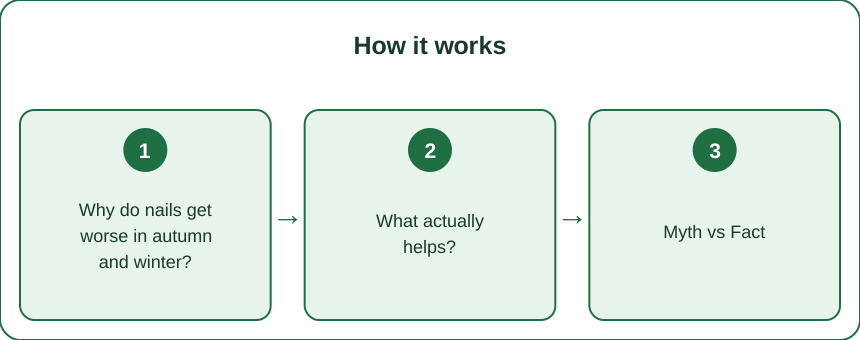
Why do nails get worse in autumn and winter?
A humidity drop on both sides - outdoors and indoors.
Nail plate contains water, and its flexibility depends on that content. Below a certain level the plate becomes brittle and splits along its layered structure rather than bending.
Cold outdoor air holds less moisture, and indoor heating dries it further. Indoor relative humidity in a heated home can fall substantially - often well below the comfortable range - which pulls water out of skin and nails continuously.
Hand washing frequency usually rises in autumn as illness season starts, and hot water plus soap strips lipids that would otherwise slow water loss.
The layered structure is why it presents as peeling. The nail plate is made of stacked keratin layers. Dehydration weakens the bonds between layers, so they separate at the free edge - which looks like peeling rather than like a clean break.
And this is why the timing is diagnostic. Nail problems that appear every October and resolve every April are environmental, not dietary. Nutritional causes do not follow the calendar.
What actually helps?
Sealing, not soaking - and the distinction matters more than any product choice.
Cuticle oil on damp nails, twice daily. Apply after washing hands while the nail is still slightly damp. The oil traps the water that is already there - applying oil to bone-dry nails seals in the dryness instead. Jojoba oil penetrates the nail plate well because its molecular size suits it.
Gloves for washing up, cleaning, and cold weather. Prolonged water exposure causes the nail to swell and contract repeatedly, which weakens the layer bonds directly. This is the single biggest preventable cause.
File in one direction with a fine grit - 240 or higher. Sawing back and forth with a coarse file shreds the layers at the free edge, which is where peeling starts. Glass files leave a smoother edge than emery boards.
Keep them shorter through winter. Less free edge means less leverage and fewer catches. A shorter nail on a dry hand is more durable than a longer one.
Skip acetone where possible, and if you must use it, oil immediately afterwards. Acetone is extremely effective at stripping oils from both nail and surrounding skin.
And avoid the soak. Long soaks feel restorative and leave nails softer and more prone to splitting for hours afterwards - which is when most people then file them.

Myth vs Fact: Nail Care
Myth: Peeling nails mean a vitamin deficiency. Fact: Environmental dryness and water exposure are far more common causes, especially when the problem is seasonal. Genuine deficiencies affecting nails - iron, for instance - exist, but they do not appear and resolve with the weather. Persistent problems warrant a doctor rather than a supplement guess.
Myth: Nails need to breathe between manicures. Fact: Nails are dead keratin with no blood supply and no respiration. The benefit of a break is avoiding removal damage, which is real - but it is about acetone and buffing, not oxygen.
Myth: Soaking nails hydrates them. Fact: Water absorbs and then evaporates, and the swell-and-contract cycle weakens the bonds between layers. Nails are softest and most vulnerable immediately after a soak, which is exactly when people file them.
Myth: Biotin fixes brittle nails. Fact: Evidence is limited and mostly from small studies in people with existing deficiency. It is unlikely to help if you are not deficient, and high-dose biotin interferes with several common blood tests - worth mentioning to your doctor if you take it.
Myth: Buffing makes nails healthier. Fact: Buffing removes layers from an already-thin plate. Occasional light buffing to smooth ridges is fine; regular buffing thins the nail and makes brittleness worse.
FAQ: Dry Nail Questions, Answered
Why do my nails peel in winter but not summer?
Because nail plate water content tracks ambient humidity, and heated indoor air in cold weather is much drier. Seasonal timing is a strong indicator that the cause is environmental rather than nutritional.
When should I apply cuticle oil?
Twice daily, on slightly damp nails after washing. Oil on dry nails seals in the dryness; oil on damp nails traps the moisture that is there.
Which oil is best?
Jojoba penetrates the nail plate particularly well due to its molecular size. Almond and vitamin E oils also work. Consistency matters far more than which one you choose.
Should I take a supplement?
Probably not for seasonal brittleness. Biotin evidence is limited outside of deficiency, and high-dose biotin interferes with several common blood tests. Persistent or worsening nail changes deserve a doctor’s assessment.
How should I file to avoid peeling?
One direction only, with a fine grit of 240 or higher. Sawing back and forth with a coarse file shreds the layered edge, which is where peeling begins.
When should I see a doctor?
If nails change colour or shape, separate from the nail bed, become thickened or pitted, or if brittleness is severe and does not follow a seasonal pattern. Those changes can reflect conditions worth investigating.
TL;DR:
- Autumn nail problems are a humidity drop, indoors and out - nail plate water content falls and the layers split.
- Seal rather than soak: cuticle oil on damp nails twice daily; long soaks leave nails softer and more fragile for hours.
- Gloves for washing up and cold weather is the single biggest preventable cause of layer damage.
- File in one direction, fine grit (240+), and keep nails shorter through winter.
- Seasonal timing means environmental, not nutritional - persistent or non-seasonal changes deserve a doctor rather than a supplement.
The reason this fix works so reliably is that it addresses water loss rather than trying to add water back, which is the step almost every routine gets backwards.
This is general information, not medical advice.
Keep Reading
This article is for general informational and styling purposes only. Fit, sizing, and product availability may vary.